If you are shopping for an air purifier in India, you have probably seen two terms on every box: HEPA and activated carbon. Some brands sell them as the same thing, and others claim one is far better than the other. The truth is simpler: they solve two different problems.
In this guide, we compare the HEPA vs activated carbon filter debate in plain language: what each filter removes, where each one falls short, how long each lasts, and which one (or which combination) is right for your home.
This matters because air pollution is a serious health issue. The World Health Organization lists particulate matter among the pollutants of major public health concern, and choosing the right filter is the first step to cleaner indoor air.
Quick Answer: HEPA vs Activated Carbon Filter
-
HEPA filters trap tiny solid particles such as PM2.5, dust, pollen, pet dander and mould spores.
-
Activated carbon filters absorb gases, odours and chemical vapours such as VOCs, cooking smells and cigarette smoke fumes.
-
Best choice for most Indian homes: an air purifier that has both, because pollution here is a mix of particles and gases.
What Is a HEPA Filter?
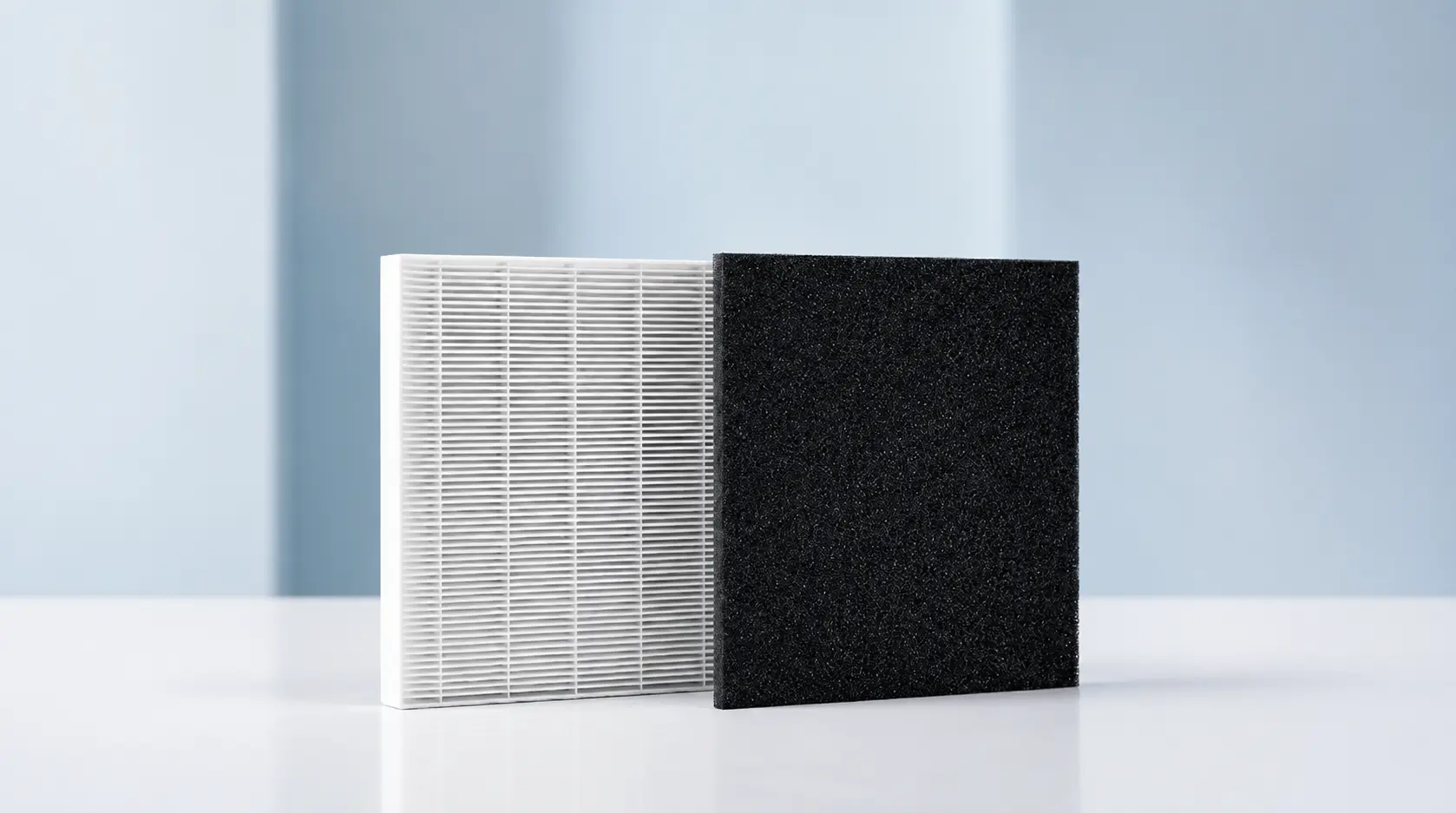
HEPA stands for High-Efficiency Particulate Air. It is a dense mesh of very fine fibres, usually made of glass. As air is pulled through, particles get stuck in the mesh by three main actions: impaction, interception and diffusion.
A true HEPA filter (for example, H13 grade) is designed to capture at least 99.95% to 99.97% of particles at the most difficult size, around 0.1 to 0.3 microns. Larger and smaller particles are generally caught even more efficiently.
What HEPA filters remove
-
PM2.5 and PM10 from vehicles, construction and crop-burning smoke
-
Dust and dust mites
-
Pollen
-
Pet hair and dander
-
Mould spores
-
Some bacteria and virus-carrying particles
What HEPA filters do not remove
-
Gases and chemical vapours (VOCs, formaldehyde)
-
Cooking, garbage, paint and smoke odours
Particles are physical objects, so HEPA can trap them. Gas molecules are far too small and simply pass straight through the fibres.
What Is an Activated Carbon Filter?
Activated carbon is charcoal (often made from coconut shell or coal) that has been treated to create millions of microscopic pores. One gram can have a surface area of hundreds of square metres.
It works through adsorption: gas molecules stick to the surface inside those pores instead of passing through. This is why carbon filters are the go-to for smells and chemical fumes.
What activated carbon filters remove
-
Volatile organic compounds (VOCs) from paint, furniture and cleaning products
-
Cooking and kitchen odours
-
Cigarette smoke smell and fumes
-
Pet and garbage odours
-
Some household gases
What activated carbon filters do not remove
-
Fine particles such as PM2.5, dust and pollen (a thin carbon layer does very little here)
-
Allergens
Also, thickness matters. A thin, carbon-coated sheet in a cheap purifier has far less capacity than a thick bed of carbon granules or a heavy carbon block.
HEPA vs Activated Carbon: Side-by-Side Comparison
| Feature | HEPA Filter | Activated Carbon Filter |
|---|---|---|
| Target pollutants | Solid particles (PM2.5, dust, pollen, dander) | Gases, VOCs, smoke fumes, odours |
| How it works | Mechanical filtration (trapping) | Adsorption (molecules stick to a surface) |
| Removes odours? | No | Yes |
| Removes PM2.5? | Yes | Barely |
| Typical lifespan | Around 6 to 12 months (varies with use and pollution) | Around 3 to 6 months (fills up faster) |
| Can it be washed? | No (washable ones are usually pre-filters) | No |
| Best for | Allergies, asthma, dusty or polluted areas | Smelly kitchens, new furniture, smokers, paint fumes |
Which Is Better: HEPA or Activated Carbon?
Neither is “better” in general. It depends on what you want to remove.
Choose HEPA first if you suffer from allergies or asthma, live near a busy road or construction site, or deal with winter smog. Particle pollution is the bigger health concern in most Indian cities, and HEPA is the filter that handles it.
Add activated carbon if you cook with strong spices and oil, have recently painted or bought new furniture, live with a smoker, or keep pets indoors.
Get both if you want complete protection. In practice, this is what most good purifiers offer.
Why a Combination Filter Works Best
Indoor air is rarely just one problem. A typical home might have PM2.5 drifting in from outside, cooking fumes from the kitchen, and VOCs from furniture and cleaners, all at once.
A well-designed purifier uses layers:
-
Pre-filter: catches hair and large dust, protecting the main filters.
-
HEPA filter: captures fine particles.
-
Activated carbon filter: adsorbs gases and odours.
Some models add a fourth stage, such as a specialised formaldehyde layer, but the HEPA plus carbon pairing is the core.
This split matches official guidance. The US EPA’s guide to air cleaners and air filters explains that mechanical filters such as HEPA remove particles, while gas-phase filters use a sorbent such as activated carbon to remove gases and odours. The EPA also warns that air cleaners that deliberately produce ozone can irritate the lungs.
Don’t Judge by the Filter Alone: Check the CADR
A purifier can have the best HEPA filter in the world and still be too weak for your room if it moves air slowly. That is where airflow performance comes in. The CADR rating of an air purifier tells you how quickly it delivers clean air, and it is the number to compare when choosing a size for your room. If you are not sure how to read it, our guide on air purifier CADR explained breaks it down step by step.
Which Air Purifier Should You Buy? (Budget Picks)
Once you know you need HEPA, carbon, or both, the next question is budget. Here is where to start:
-
Tight budget: Check our list of the best air purifier under ₹5,000. At this price, expect smaller rooms and lighter carbon layers, so match the model to your room size.
-
Mid-range, better filtration: Our guide to the best air purifier under ₹10,000 in India covers models with stronger HEPA filtration and more useful carbon filters, which is the sweet spot for most families.
Common Myths About HEPA and Carbon Filters
Myth 1: “Carbon filters remove dust and PM2.5.” Not effectively. Carbon is built for gases and odours. You need HEPA for particles.
Myth 2: “HEPA filters remove smells.” They do not. Smoke particles get trapped, but the smell comes from gases that pass straight through.
Myth 3: “HEPA-type or HEPA-like is the same as true HEPA.” No. These terms are marketing language and usually mean lower efficiency. Look for H13 or H14, or a stated 99.97% at 0.3 microns.
Myth 4: “Carbon filters last forever.” Carbon becomes saturated once its pores are full, and after that it stops working. Replace it on schedule.
Myth 5: “More filter stages always means better.” Not necessarily. Airflow, filter quality, carbon quantity and a proper seal matter more than the number of stages.
Buying Tips: What to Look For
-
True HEPA (H13 or higher), not “HEPA-type”.
-
A thick carbon filter, not a thin coating, if odours or VOCs are a concern.
-
CADR matched to your room size. Check it using the guide linked above.
-
Filter replacement cost and availability. Cheap purifiers with expensive filters cost more over time.
-
Noise level at the speed you will actually use.
-
Avoid ozone-generating purifiers. Ozone is a lung irritant and is not a safe way to clean air.
How to Maintain Your Filters
-
Clean the pre-filter every 2 to 4 weeks (when washable, per the manual).
-
Replace HEPA and carbon filters when the indicator says so, or sooner in heavy pollution or smoke seasons.
-
Keep doors and windows closed while the purifier runs.
-
Place the purifier away from walls, with space around it for airflow.
Final Verdict
HEPA and activated carbon are not rivals. HEPA cleans the particles you can breathe in, and activated carbon cleans the gases and smells you can notice. For most Indian homes, where PM2.5 and cooking fumes both matter, an air purifier with HEPA plus activated carbon gives the best all-round protection.
Ready to choose? Start with the best air purifier under ₹5,000 if you are on a budget, or step up to the best air purifier under ₹10,000 in India for stronger performance, and check the CADR rating before you buy.